A-142-5(1U) Dual Decay/LFO
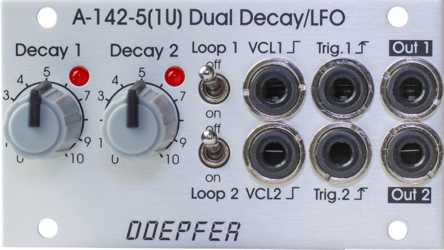
A-142-5 besteht aus zwei einfachen Hüllkurvengeneratoren,
die auch als A/D-LFO arbeiten können. Die Umschaltung zwischen Hüllkurve und
LFO erfolgt mit Hilfe des Loop-Kippschalters. Steht dieser in der Position
"off", arbeitet die Einheit als Hüllkurvengenerator und die
Hüllkurve wird durch die positive Flanke des an der Buchse "Trig."
anliegenden Triggersignals gestartet.
Die Trigger-Eingänge sind normalisiert (1->2).
Steht der Schalter auf "on", so arbeitet die Einheit als LFO.
Das Module verfügt zusätzlich über einen Steuereingang "VCL" (voltage
control loop), mit dem die betreffende Einheit über ein externes Steuersignal
auf "Loop on" geschaltet werden kann, sofern der Schalter auf "Loop
off" steht. Es handelt sich um ein digitales Steuersignal (high/low) und
die Spannung muss bei ca. +3,5V oder höher liegen, damit die Umschaltung
erfolgt.
Wird im LFO-Betrieb ein Trigger-Signal zugeführt, so überlagern sich die
Hüllkurve und der LFO.
Es steht für jede Einheit der Zeit-Parameter "Decay" zur Verfügung.
Damit kann die Abklingzeit im
Bereich von ca. 2 ms bis 2 Sekunden manuell eingestellt werden. Die Attack-Zeit
kann mit
Hilfe eines Trimmpotentiometers für jede Einheit zwischen ca. 1 ms und 15 ms
fest eingestellt werden. Ab Werk sind ca. 3 ms voreingestellt. Das
entspricht dem Attack-Wert der TB-303.
Das Signal erscheint am Hüllkurven/LFO-Ausgang "Out". Der
Spitzenwert der Hüllkurve bzw. des LFOs liegt bei ca. +10V.Das Signal
wird mit einer LED optisch angezeigt.
Vorschläge für Modifikationen:
-
Durch Austauschen eines Kondensators können die Attack/Decay-Zeiten in andere Bereiche verschoben werden (z.B. 0,2 ms ... 0,2 Sekunden oder 20 ms ... 20 Sekunden)
Module A-142-5 contains two simple envelope
generators which can work also as A/D LFOs. For the switching between envelope
and LFO the toggle switch "Loop" is used. When in position
"off" the unit in question works as an envelope generator and the
envelope is triggered by the positive edge of the trigger signal applied to
socket "Trig.". The trigger inputs are normalled (1->2).
When the Loop switch is in position "on" the unit in question works as
an LFO.
The module features a control input "VCL" (voltage control loop). A
high level applied to this socket turns loop "on" and the unit works
as an LFO provided that the switch is in "off" position. The VCL input
expects a digital high/low signal and the voltage level has to be about +3.5V or
more to activate the switching.
When a trigger signal is applied in LFO mode the envelope and LFO interfere with
each other.
Each unit has a Decay control that is used to adjust the decay time manually in
the range of about 2 ms ... 2 seconds. The attack time can be adjusted
internally by means of a separate trimming potentiometer for each sub-unit in
the range 1 ms ... 15 ms. The factory setting is about 3 ms. This is the attack
time of the TB303.
The signal appears the envelope/LFO output "Out". The peak voltage is about +10V. The
signal is displayed by an LED.
Suggestions for modifications:
-
By changing the value of a capacitor the time range can be modified (e.g. 0.2 ms ... 0.2 seconds or 20 ms ... 20 seconds)
Höhe/Height: 1HE / 1U / 44.45 mm
Breite/Width: 14 TE / 14 HP / 70.8 mm
Tiefe/Depth: 45 mm
(gemessen ab der Rückseite der Frontplatte / measured from
the rear side of the front panel)
Strombedarf/Current: +10mA (+12V) / -10mA (-12V)
Standard Version : Euro 90.00
Vintage Edition : Euro 95.00
The price in US$ depends upon the exchange rate between Euro and US$ at the payment day.