A-190-5 Polyphonic USB/Midi-to-CV/Gate Interface
Detailed report of all polyphonic modules: https://youtu.be/5HqfjNGVsDU
|
click to enlarge |
|
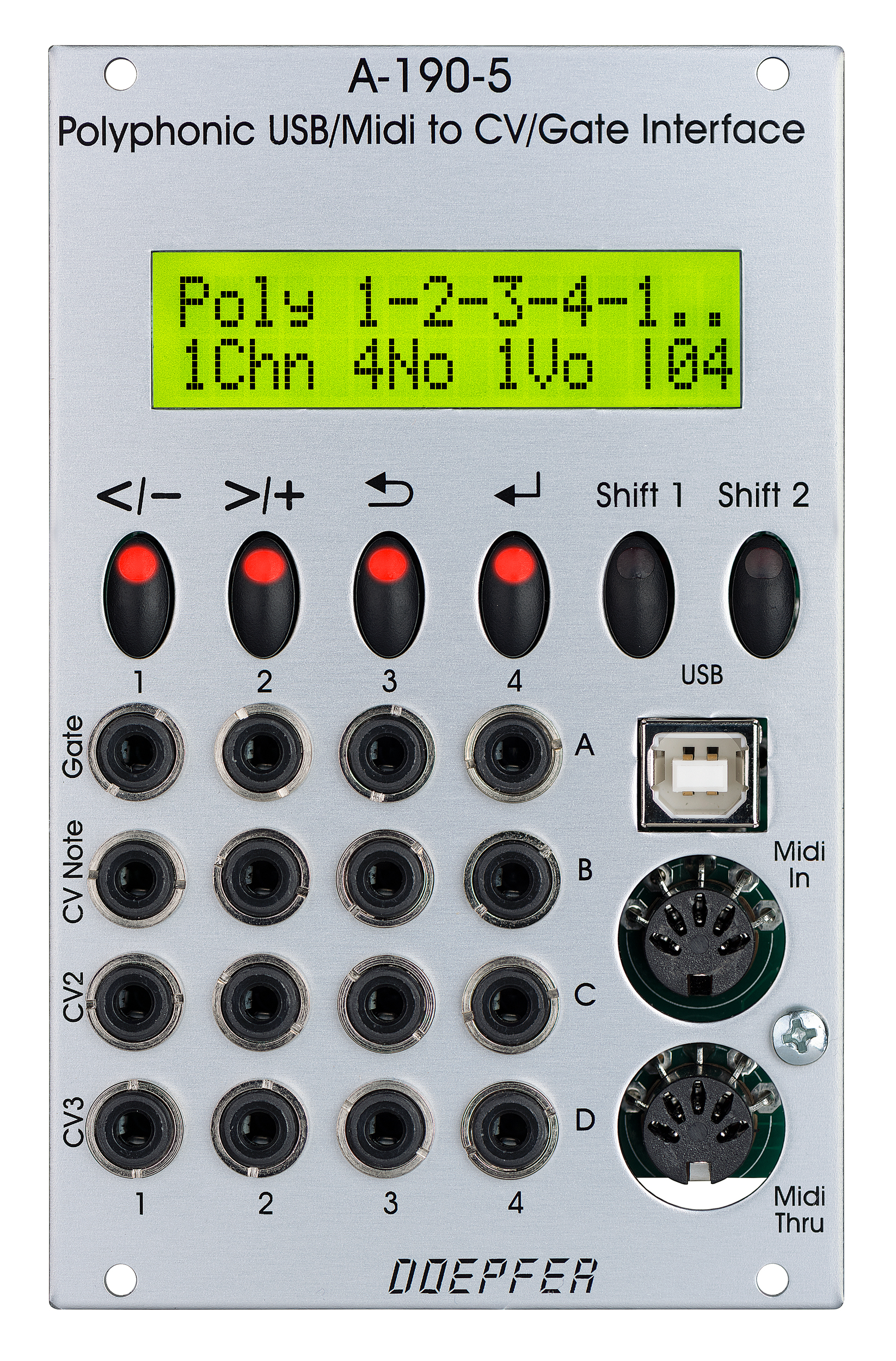
Das Modul A-190-5 ist ein 4-stimmiges Midi/USB-to-CV/Gate-Interface. Für jede Stimme steht eine Tonhöhen-Steuerspannung
(CV1, 1V/Oktave zur Steuerung von VCOs), ein Gate-Ausgang (zur Ansteuerung der
Hüllkurven-Generatoren) sowie zwei weitere Steuerspannungen CV2 und CV3 zur Verfügung. Die
beiden zusätzlichen Steuerspannungen können z.B. über Midi Velocity, Volumen,
Modulation, After-Touch oder frei wählbare Midi-Controller
gesteuert werden.
Alle CV-Ausgänge besitzen 12 Bit Auflösung, der Spannungsbereich beträgt
0-10V.
Folgende Betriebsarten sind verfügbar:
- 4-stimmig monophon (d.h. zur Steuerung von 4 monophonen Stimmen auf 4 aufeinanderfolgenden Midi-Kanälen)
- 4-stimmig polyphon (d.h. zur Steuerung von 4 monophonen Stimmen auf einem Midi-Kanal)
- 2-stimmig polyphon (d.h. zur Steuerung von 2 monophonen Stimmen auf einem Midi-Kanal)
- unisono
- alle anderen in der aktuellen Version verfügbaren Betriebsarten entnehmen Sie bitte der Bedienungsanleitung: A190_5_anl.pdf
Die Betriebsarten werden Hilfe von Tastern angewählt und im Display angezeigt. Innerhalb einer Betriebsart sind gewisse Parameter (z.B. der oder die Midi-Kanäle, Referenzton für 0V CV, zugewiesene Controller für CV2 und CV3 etc.) editierbar. Die Werte der betreffenden Parameter werden mit Hilfe weiterer Bedientaster eingestellt und im Display dargestellt. Im normalen Betriebsmodus arbeiten die LEDs der ersten 4 Taster als Gate-Anzeigen.
Bedienungsanleitung: A190_5_anl.pdf
Bei Rückfragen zur Bedienung wenden Sie sich bitte an software@doepfer.de.
Updates mit zusätzlichen Betriebsarten oder Bug-Fixes können ggf. vom
Kunden über das USB-Interface durchgeführt werden.
Das folgende Dokument zeigt
die Positionen und Funktionen der Stiftleisten, die für die interne
Verdrahtung mit den anderen polyphonen Modulen verwendet werden können (Gate
1-4, CV Note 1-4): A190_5_pin_headers.pdf
Das folgende Dokument enthält grundsätzliche Hinweise zur internen
Vorverdrahtung der polyphonen Module A100_internal_polyphonic_wiring.pdf
Technischer Hinweis:
Alle Midi-Daten auf dem Legacy Midin und dem USB MidiIn werden direkt auf dem Legacy MidiOut und dem USB Midiout ausgegeben. Bei einer Kombination aus Legacy Midi und USB Midi kann dies manchmal hilfreich sein.
Wenn Midi Events jedoch direkt vom USB-Eingang zum USB-Ausgang zurückgespiegelt werden, ist dies
eigentlich nicht so nützlich, sondern führt eher Problemen.
Wenn die DAW, die Events an den A190-5 sendet, diese direkt über einen Midi-In
vom A190-5 zurückgesendet bekommt, haben wir eine
Midi-Rückkopplungsschleife.
Was genau dann passiert, hängt von vielen Faktoren ab - aber meistens passiert nichts ‚Gutes‘ - die DAW oder das Gerät scheinen dann seltsame Dinge zu tun..
Im Moment gibt es keine Möglichkeit, dies auf dem A190-5 zu vermeiden. Dies wird im nächsten Update behoben.
Seitens der DAW muss also nun verhindert/abgeschaltet werden, dass Events auf dieselbe Spur zurückkommen
können, von der sie bereits an das A190-5 gesendet wurden, in der eine Midi-to-Verbindung zur A190-5 besteht. ..
Module A-190-5 is a four voice Midi/USB to
CV/Gate
interface. For each voice a pitch control voltage (CV1, 1V/octave standard to control VCOs), a gate
output (to control envelope generators) and two additional control voltages
(CV2, CV3) are available. The two additional CV outputs can be controlled
by Midi velocity, volume, modulation, after touch or free assignable Midi
controllers.
The resolution of the CV outputs is 12 bit and the voltage range is 0-10V.
These modes are available:
- four voice monophonic (i.e. to control four monophonic voices by four succeeding Midi channels)
- four voice polyphonic (i.e. to control four monophonic voices by one Midi channel)
- two voice polyphonic (i.e. to control two monophonic voices by one Midi channel)
- unisono
- details about all available modes of the current firmware version can be found in the user's manual: A190_5_man.pdf
The mode is selected by means of momentary switches and is shown in the LC display. Certain parameters of each mode can be edited (e.g. the midi channel(s), the midi reference note for 0V CV, assigned controllers for CV2 and CV3). The parameter values (e.g. midi channels) are shown in the display and can be modified by means of the momentary switches. In Play mode the LEDs of the first four switches display the gate states.
User's manual: A190_5_man.pdf
If you have questions please contact software@doepfer.de.
Updates and bug fixes can be installed by the customer via
the USB interface if applicable.
The following document shows the
positions and functions of the pin headers that can be used for internal
pre-patching to other polyphonic modules (gate 1-4, CV Note 1-4): A190_5_pin_headers.pdf
The following document contains basic information about the internal
pre-wiring of polyphonic modules: A100_internal_polyphonic_wiring.pdf
Technical note:
All midi data on the Legacy Midin and the USB MidiIn are output directly to the Legacy MidiOut and the USB Midiout. In the case of a combination of Legacy Midi & USB Midi, this can sometimes be useful.
But if events are mirrored back directly from the USB-In to the USB-Out, this is actually not very useful, rather it results in a real danger and a problem.
If the DAW that sends events to the A190-5 gets them back directly via a midi-in
from the A190-5, then we have a
midi feedback loop.
What exactly happens then depends on many factors - but mostly nothing good - the DAW, or the device then seems to do strange things, hang up etc ...
At the moment there is no way to fix this on the A190-5, this will be addressed in the next update.
On the part of the DAW it must now be prevented that events come back to the same track from which they were already sent to the A190-5, in which there is a 'midi to' connection to the A190-5. ..
Tiefe/Depth: 55 mm (gemessen an Rückseite der Frontplatte / measured from the rear side of the front panel)
Strombedarf/Current: +120mA (+12V) / -40mA (-12V) mA
The price in US$ depends upon the exchange rate between Euro and US$ at the payment day.